I've had quite a bit more reading time than usual while we've been here in Chile--between my own reading, the books I've read with the girls during school time (I'm only counting real chapter books here), and Jonathan reading out to us at bedtime, I've almost finished 15 books since the beginning of 2015. In my normal life I'm lucky if I get through that many books in a full year. (Note to future self: too busy to read = too busy.)
I'm not so sure why it took me this long to look up a Chilean author. I guess I had a lot of other books in my queue, and for one reason or another it wasn't until a few weeks ago that I started pitching around to find some writing about this place. After discovering a couple of poorly written memoirs by Americans, chronicling their adventures trekking across South America (that, in the end, I couldn't motivate myself to plow through), I googled "Top Chilean Authors" and up popped a list of ten novelists. Unsurprisingly I was drawn to the females among them, and thus landed upon Isabel Allende.
Her first two (and most popular) novels are not available in Kindle form, so I ended up with her book called "Paula." I didn't realize when I purchased it, but this book turned out to be her memoir, started as a letter to her critically ill daughter who was in a coma at the time, and which spun into a full-length book.
Wow.
I am completely smitten with this woman and her writing. How did I get this far in life without knowing her work? I'm completely ruined for reading anything now, because nothing measures up to that level.
And the way that she talks about Chile, and Santiago, and the fact that during the military coup she conducted a lot of her clandestine activities up on San Cristobal--my San Cristobal! where I've been hiking multiple times per week since we arrived here!--just brings it right on home. I knew about the military coup, but reading about it through her experience enabled me to really understand a lot more of what went on here.
I can't wait to get my hands on her earlier books--House of the Spirits, City of the Beasts, and Eva Luna: A Novel. I plan to order them on amazon so they are sitting on my doorstep when I arrive back in Pittsburgh in a few weeks.
I should probably explore some of the other award-winning authors who call this place home, but Isabel Allende will keep me pleasantly tied up for awhile.
Friday, March 27, 2015

Wednesday, March 25, 2015
Geysers
Tuesday morning, up at 4am to see the Geysers. The tour takes you up into the mountains where there is a lot of thermal activity. First thing in the morning is ideal to see that area because the cooler air makes the steam more visible, and also the rising sun creates a dramatic lighting effect.


We learned that there are 500 volcanoes in Chile, and 123 of them are active. Villarica, towards the South, is the one that erupted just several weeks ago (there was no noticeable atmospheric effect in Santiago).


We stopped and explored the small pueblo of Machuca. Historically herders and animal breeders lived here. They would domesticate the vicuña (the domesticated animal is the alpaca) and the guanaco (the domesticated version being the llama). The animals were moved and traded across the Andes mountains between what is now Chile and Argentina. Currently the pueblo is mostly uninhabited, but is kept up for the purpose of tourism and preserving an historically important site.


We also saw some saguaro growing on the ridges.

In one spot there was a particularly lush valley (probably more so due to the excessive rain throughout the previous week) and the foliage down in the gully was vibrantly green, contrasting with the saguaros up on the edge of the ridge.

 |
| There were larger geysers and also little tiny gurglers like this one. |
Just a short distance across the valley from the geysers is a thermal pool that you can bath in. It turned out to not be such a dramatic "hot springs" as we expected. The outside temp was a few degrees below freezing, so we were already cold. You could see the steam rising from the pool, but it turned out that there were only a few small places where the water was actually very warm. The temperature throughout the pool varied by at least 20 degrees, so there were places that were really cold, as well as a few spots that were tolerably warm. We did manage to all get in the water, but we didn't stay for long.
We saw more vicuña on the way down.
 |
| This is the site of an old Italian mine. The miners apparently caused a scandal back in the day by bringing up prostitutes from Calama to keep them company. |
We stopped and explored the small pueblo of Machuca. Historically herders and animal breeders lived here. They would domesticate the vicuña (the domesticated animal is the alpaca) and the guanaco (the domesticated version being the llama). The animals were moved and traded across the Andes mountains between what is now Chile and Argentina. Currently the pueblo is mostly uninhabited, but is kept up for the purpose of tourism and preserving an historically important site.
 |
| The church at Machuca |
I have an obsession with cool doors and Machuca did not disappoint.
Lots of volcanic rock around Machuca (and throughout the whole region).
 |
| Another building in Machuca. The crosses on the top were to fend off evil spirits. Some of them may have also appeared during the Spanish conquest when the natives were forced to take on Catholicism. Putting a cross above your house was a way to show that you were at least playing along with the demands of the conquistadores. |
On our way out of Machuca we saw some of the few animal herds that are still kept in the area.
We also saw some saguaro growing on the ridges.
In one spot there was a particularly lush valley (probably more so due to the excessive rain throughout the previous week) and the foliage down in the gully was vibrantly green, contrasting with the saguaros up on the edge of the ridge.
One of the funnest parts of the tour was when the driver stopped in a spot that looked for all the world like we were going uphill. He came to a full stop, turned off the engine, and removed the keys from the vehicle. Then when he lifted the brakes we started coasting, but forwards--seemingly up the hill. It was the weirdest thing ever. He got a huge applause from everyone on the bus. It must have been an optical illusion, but a pretty darn convincing one!
We got back to San Pedro de Atacama with just enough time to grab a final lunch and head to the hotel for our airport pickup. As it turned out, that was the one time we actually got drenched (having been fortuitously indoors or under cover during all the other cloudbursts). Once we got to the hotel we were furiously changing, stuffing our clothing (ranging from damp to soaked) into the suitcases, and trying to get dry and a bit less bedraggled for the trip back home.
Sadly it was overcast all the way back to Santiago so we didn't have any mountain views. I'm sad because in two weeks when we leave to come back to the States (it's only two weeks! yikes!), our flight is after dark so this really was our last chance for those spectacular from-the-air vistas.
Today in Santiago it remains primarily overcast, although the fog lifted long enough for me to see that there is a LOT more snow on our mountains than when we left several days ago.
Laguna Cejar
Thunderstorms were predicted for Monday late afternoon, and although most tours to Laguna Cejar left around 4pm, after a bit of searching we found one that was planning to leave at 2pm in order to avoid the storm.
Laguna Cejar is a salt lagoon that is famous for its turquoise color. Right beside it is another lagoon in which you can swim and experience the strange buoyancy of highly salty water. It was the weirdest and coolist sensation ever! If you let your limbs relax, they just popped up to the surface. If you went on your stomach, as J and Tulip are in this picture, it took a bit of effort to pull them back down and "right" yourself. The water was not super warm, but comfortable, and we stayed and played there for awhile. The view wasn't so bad either. ;-)

After we got out of the water, the salt caked on our skin and formed interesting crystallized patterns. Thankfully there was a bathhouse there with showers to rinse off.


After hanging out in the water for awhile and getting cleaned up, our guide put out some snacks and drinks: Pisco Sour, of course (which is the big thing to drink in Chile--whole aisles in the grocery stores are dedicated to it!) and orange juice. I hadn't tried Pisco Sour since we don't really drink, but I gave it a taste. It's alright, but not really life-changing (Sorry, Chileans! But I did try it, and I have a picture to prove it!)

Our driver said that although he always brings orange juice, he is usually the only one drinking it since everyone else normally wants Pisco Sour. He was thrilled to have some drinking buddies on this excursion.

As we were enjoying our snack under a shelter, we saw the storm roll in. All the folks who signed up for the normal 4pm tours were just arriving and speculating about whether they should swim in the lake with lightning striking all around. We were SO glad we had come earlier when it was not only safe, but also warmer! Sure enough, just as we got back to town, it started really raining in earnest. Thankfully the storm exhausted itself during our dinner and by the time we walked back to our hotel it had let up.
Most nights after the storm the sky had cleared up around 9 or 10, but nevertheless the official stargazing astronomic tours were cancelling left and right (we had signed up two nights in a row already and they had been cancelled). However, J managed to find one that said they would go at 11pm Monday night. Since we were getting up at 4am the next morning to go to the Geysers, I opted to go back to the hotel with the girls so we could get some sleep. After walking down to the agency at 11, he learned that they were postponing the tour until midnight. He came back to the hotel for a few minutes to rest and then went out again. With me drifting in and out of sleep and not really aware of what was going on, it made for an interesting night.
2am J arrives at the room.....
Me, sitting up in bed: *????*
J: I just got back from stargazing
Me: Didn't you already get back before?
J: Yes.
Me: *????*
I wasn't really all that cognizant, to be honest, but I do have a vague memory of all this transpiring. The girls of course slept through all of it without even stirring.
Most nights after the storm the sky had cleared up around 9 or 10, but nevertheless the official stargazing astronomic tours were cancelling left and right (we had signed up two nights in a row already and they had been cancelled). However, J managed to find one that said they would go at 11pm Monday night. Since we were getting up at 4am the next morning to go to the Geysers, I opted to go back to the hotel with the girls so we could get some sleep. After walking down to the agency at 11, he learned that they were postponing the tour until midnight. He came back to the hotel for a few minutes to rest and then went out again. With me drifting in and out of sleep and not really aware of what was going on, it made for an interesting night.
2am J arrives at the room.....
Me, sitting up in bed: *????*
J: I just got back from stargazing
Me: Didn't you already get back before?
J: Yes.
Me: *????*
I wasn't really all that cognizant, to be honest, but I do have a vague memory of all this transpiring. The girls of course slept through all of it without even stirring.
Valle de la Luna
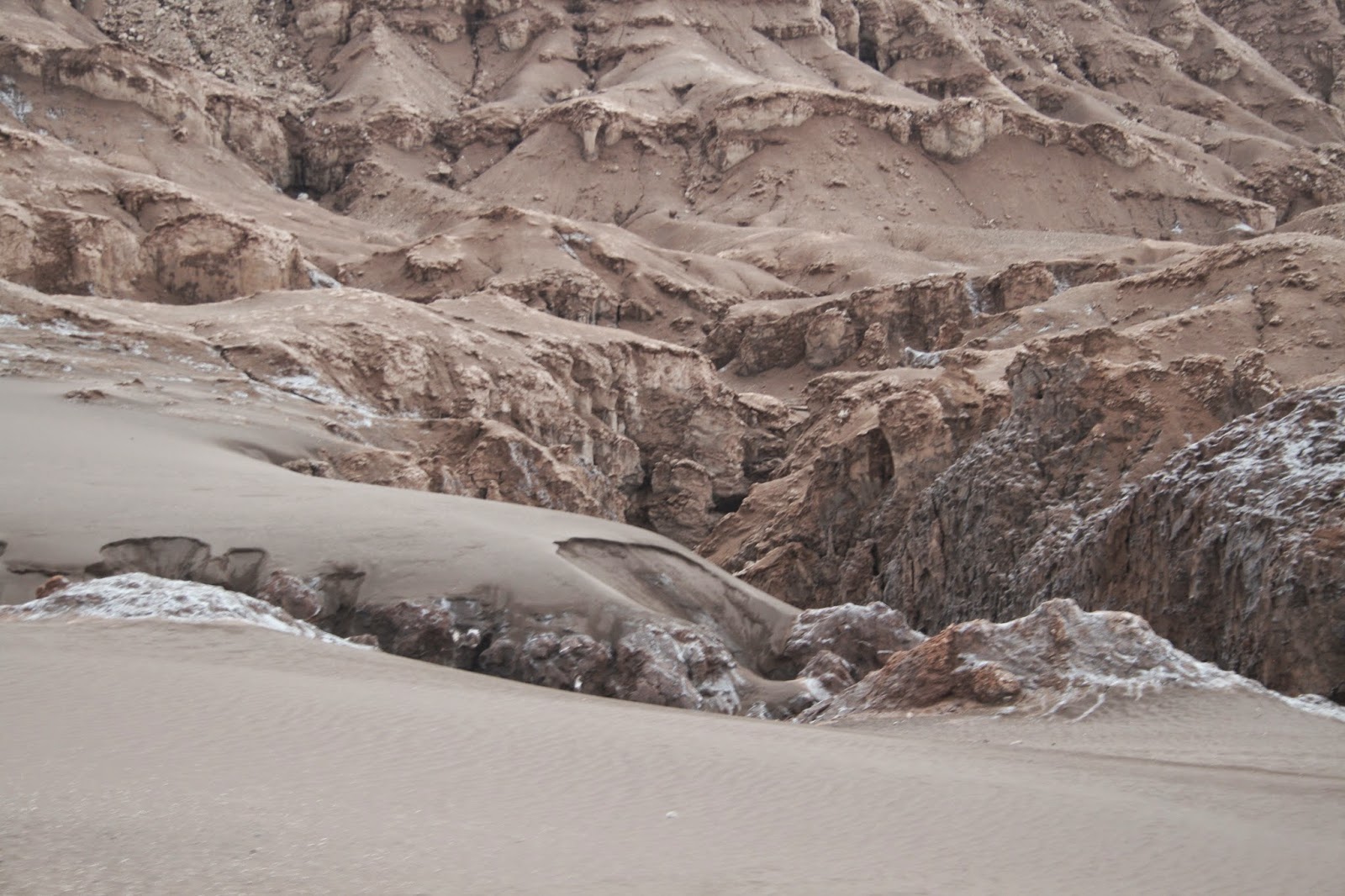
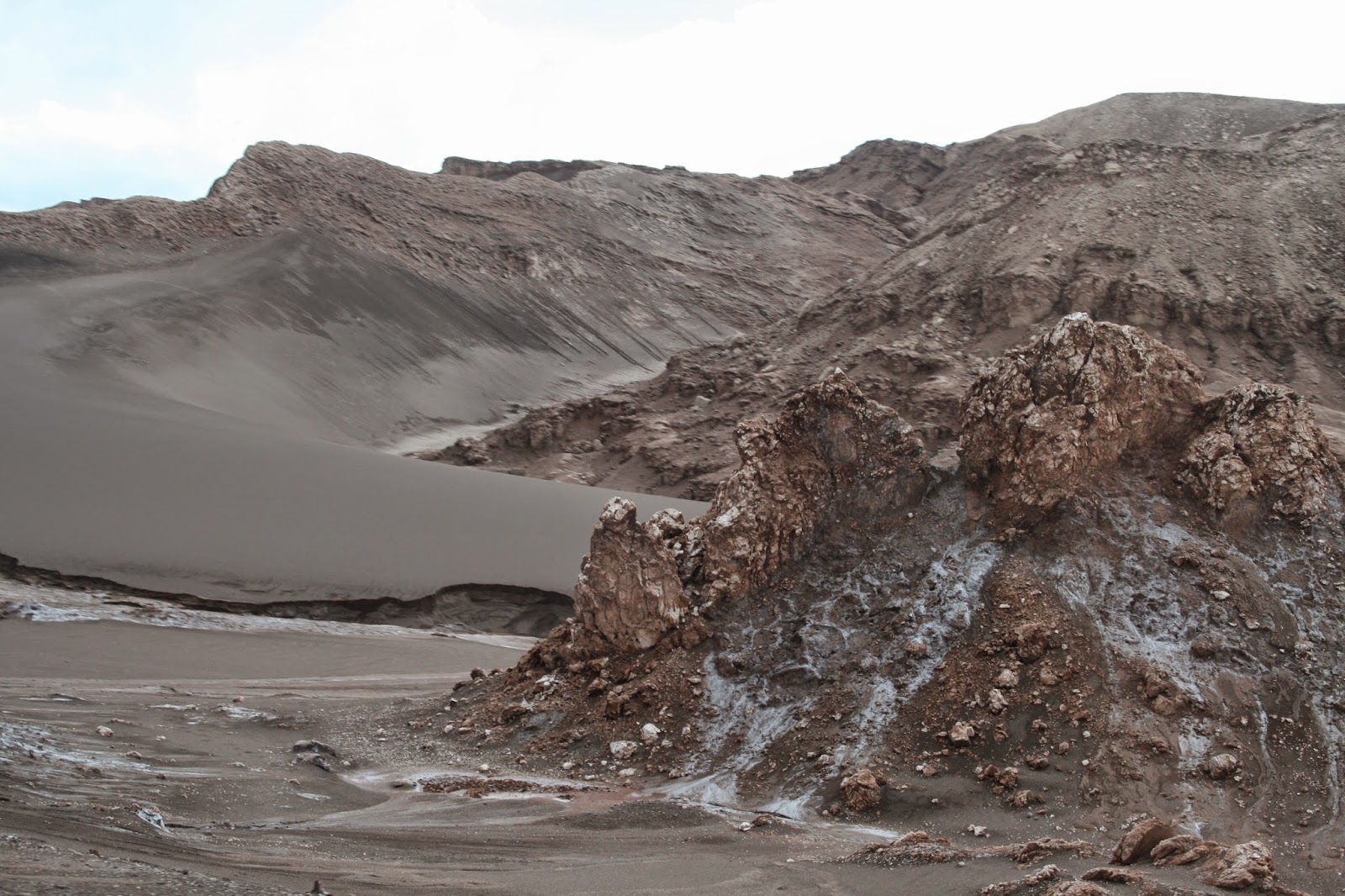
We learned that the cool salt formations we drove through on our way into town are called the "Cordillera de Sal" (Salt Range) and are on the periphery of an area called Valle de la Luna (Valley of the Moon). On Sunday we found a tour to the area and kept our fingers crossed that we wouldn't get rained on.





This was the most fun: pick up "rocks" from the ground, and then crush them with your bare hands!


The static electricity in the air made for fun hair as well! :-)


After climbing up and seeing the area from above, we went down to the salty area in the valley. This is an area called the "Tres Marias" (Three Marys") The person who discovered this site believed that the natural rock formations depicted three different prayer stances of Mary. On the left Mary is lying prostrate, the middle "statue" depicts Mary with her hands clasped together in prayer over her head, and the figure on the right is kneeling. Our tour guide pointed out that the site should be renamed the "Two-and-a-half Marys" because in 1996 a careless and ignorant tourist climbed up the figure on the right and knocked the head off. That stone now rests directly in front of the figure on the ground.


This is the next valley over from Valle de la Luna and is called Death Valley.


 |
| We thought this mud looked a lot like chocolate gelato. |
 |
| The paths were seriously eroded from the heavy rains |
 |
| Our guide, Adam |
 |
| In the valley, salt. On the mountains, snow. (Someone on our tour asked if the white on the mountains was salt!) :-) |
 |
| The girls speculating about sliding down the sand slope.... (if it had been allowed, they would had done it in a heartbeat) |
There was a storm brewing the whole time we were at the Valle de la Luna. We could see lightning on the next peak over and we felt a few raindrops. The dark storm clouds were rolling in and colliding with the puffy white clouds. Dramatic!
The static electricity in the air made for fun hair as well! :-)
After climbing up and seeing the area from above, we went down to the salty area in the valley. This is an area called the "Tres Marias" (Three Marys") The person who discovered this site believed that the natural rock formations depicted three different prayer stances of Mary. On the left Mary is lying prostrate, the middle "statue" depicts Mary with her hands clasped together in prayer over her head, and the figure on the right is kneeling. Our tour guide pointed out that the site should be renamed the "Two-and-a-half Marys" because in 1996 a careless and ignorant tourist climbed up the figure on the right and knocked the head off. That stone now rests directly in front of the figure on the ground.
 |
| Rainbow! |
 |
| This area is called the "Amphitheater" |
This is the next valley over from Valle de la Luna and is called Death Valley.
At sunset we went to a point overlooking Valle de la Luna to watch the sun go down and see the colors changing.
 |
| The colors were even more dramatic over the mountains (towards the East) than they were in the direction of the sunset |
Subscribe to:
Posts (Atom)